
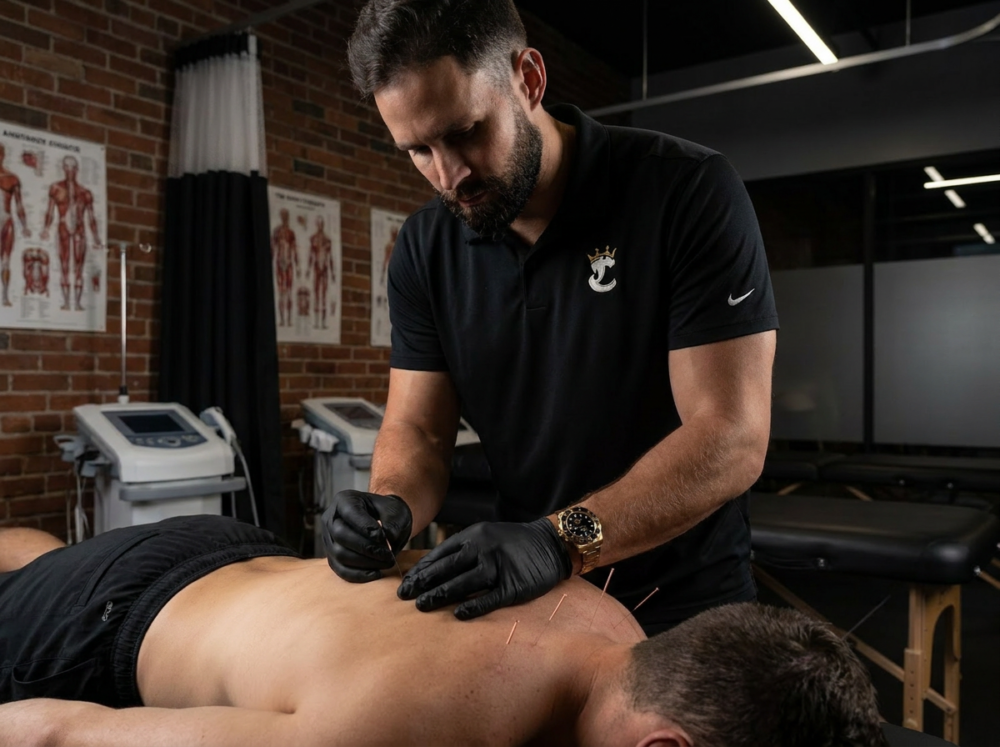
Muscle tension and sports injuries do not always resolve on their own, even with rest and standard rehabilitation. For athletes, active individuals, and people dealing with persistent muscular pain, dry needling has become an increasingly recognised tool in the recovery process.
This post explains what dry needling is, how it works, what the research supports, and what you can reasonably expect from this type of therapy.
What Is Dry Needling?
Dry needling is a therapeutic technique performed by trained clinicians that involves inserting thin, solid filiform needles directly into muscle tissue. The needles used contain no medication or injection fluid, which is why the technique is described as “dry.”
The primary targets are myofascial trigger points, which are tight, hypersensitive knots within muscle fibres that can cause both localised pain and referred pain in other areas of the body. A trigger point in the upper trapezius, for example, can refer pain into the neck and the side of the head. Dry needling works by disrupting these dysfunctional tissue areas and stimulating a physiological response that promotes muscle relaxation and tissue recovery.
It is worth noting that dry needling is distinct from acupuncture. While both use similar needles, they are based on different frameworks. Acupuncture is rooted in traditional Chinese medicine and works along energy meridians. Dry needling is grounded in musculoskeletal anatomy and neuroscience, with needle placement guided by clinical assessment of the individual’s muscle and pain patterns.
How Dry Needling Works on Muscle Tissue
When a needle is inserted into a trigger point, it often produces what clinicians call a local twitch response. This is an involuntary contraction of the muscle fibres within the trigger point, and it is generally considered a positive sign that the correct tissue has been targeted.
This twitch response is followed by several physiological effects that contribute to the therapeutic benefit:
-
The tight band of muscle fibres relaxes, reducing stiffness and improving range of motion
-
Blood flow to the area increases, bringing oxygen and nutrients to tissue that may have been in a state of relative ischaemia
-
The nervous system response is altered, reducing the hypersensitivity of pain receptors in the area
-
Inflammatory markers associated with trigger point activity begin to decrease
The result, over a course of treatment, is reduced pain, improved muscle function, and faster recovery from injury or overuse.
Dry Needling for Sports Injuries
Sports injuries often involve more than structural damage to tendons, ligaments, or bones. Muscle guarding, compensatory movement patterns, and trigger point formation frequently develop around an injury site as the body tries to protect the damaged area. These secondary muscular issues can persist long after the original injury has healed, contributing to ongoing pain, reduced performance, and increased risk of re-injury.
Dry needling addresses these muscular components directly. Some of the most common sports-related applications include:
Hamstring Strains
Hamstring injuries are among the most frequent in running and field sports. Dry needling can help address the residual trigger points and muscle tightness that often remain after the initial healing phase, supporting fuller restoration of flexibility and strength.
Rotator Cuff Issues
Shoulder injuries involving the rotator cuff frequently produce significant muscular tension and altered movement patterns in the surrounding muscles. Dry needling to the rotator cuff muscles and associated shoulder girdle tissue can help restore normal muscle activation and reduce pain during movement.
Plantar Fasciitis
While plantar fasciitis is technically a condition of the fascia, the calf muscles and intrinsic foot muscles are frequently involved in its persistence. Dry needling to the gastrocnemius, soleus, and tibialis posterior can reduce the load on the plantar fascia and support resolution of symptoms.
IT Band Syndrome
Lateral knee pain associated with iliotibial band syndrome often involves trigger points in the tensor fasciae latae and gluteus medius. Dry needling these muscles alongside other rehabilitation work helps address the underlying cause rather than just the symptomatic area.
Lower Back Pain in Athletes
Lumbar pain is common across almost all sports. Dry needling to the paraspinal muscles, quadratus lumborum, and gluteal muscles can provide meaningful pain relief and improved mobility as part of a broader treatment plan.
For athletes and active individuals in the Miami area, dry needling therapy at Castle Athletics and Recovery is delivered by clinicians experienced in sports-specific applications of this technique.
Dry Needling for Muscle Tension and Chronic Tightness
Not all candidates for dry needling are dealing with acute sports injuries. Chronic muscle tension, whether from occupational posture, stress, sedentary habits, or repetitive movement patterns, responds well to dry needling when the source of that tension is trigger point activity.
Common presentations include:
-
Persistent upper back and neck tightness related to prolonged desk work
-
Tension headaches originating from trigger points in the suboccipital and upper trapezius muscles
-
Hip flexor tightness in people who sit for long periods
-
Recurring calf tightness in runners or those with postural imbalances
In these cases, dry needling is often combined with mobility work, corrective exercise, and postural guidance to address the contributing factors rather than simply providing temporary relief.
What to Expect During a Dry Needling Session
Understanding what happens during a session helps manage expectations and reduces any anxiety around the treatment.
Initial Assessment
A clinician will begin by taking a history of your symptoms, activity levels, and any relevant injury or medical background. This informs the specific muscles and trigger points that will be targeted.
Needle Insertion
The needles used in dry needling are very fine, significantly thinner than hypodermic needles used for injections. Most people describe the initial insertion as a mild sensation. When the needle reaches a trigger point and a twitch response occurs, there may be a brief cramping or aching sensation. This is normal and typically short-lived.
Duration and Number of Needles
A typical session lasts between 30 and 60 minutes. The number of needles used varies based on the area being treated and the extent of the trigger point involvement. Some sessions focus on a single region, while others address multiple areas if the clinical picture warrants it.
Post-Session Response
It is common to experience some soreness in the treated muscles for 24 to 48 hours after a session, similar to the feeling after an intense workout. This is a normal part of the physiological response and generally resolves quickly. Some people notice immediate improvement in pain or mobility; for others, the benefit accumulates over several sessions.
Dry Needling vs Other Recovery Approaches
The following table compares dry needling with several other commonly used recovery and soft tissue therapies.
|
Therapy |
Method |
Primary Target |
Best Suited For |
|---|---|---|---|
|
Dry needling |
Needle into trigger point |
Myofascial trigger points, muscle tissue |
Sports injuries, chronic tension, referred pain |
|
Sports massage |
Manual pressure and movement |
Superficial and deep muscle tissue |
General recovery, circulation, relaxation |
|
Foam rolling |
Self-applied pressure |
Superficial fascia and muscle |
Maintenance, warm-up, general tightness |
|
Cupping therapy |
Suction on skin surface |
Fascia, superficial tissue |
Circulation, mild tension relief |
|
Shockwave therapy |
Acoustic wave energy |
Tendon and chronic soft tissue conditions |
Tendinopathy, calcifications, chronic injuries |
|
Stretching and mobility work |
Passive or active lengthening |
Muscle length and joint range |
Flexibility, movement quality, injury prevention |
Dry needling does not replace these approaches but works alongside them. Many clinicians use a combination of techniques within a single session or across a treatment programme, depending on what the individual needs.
Who Is a Suitable Candidate for Dry Needling?
Dry needling is appropriate for a broad range of people, including recreational athletes, competitive sports participants, and individuals dealing with musculoskeletal pain outside of sport. It tends to be most effective when:
-
Pain or restricted movement is associated with identifiable trigger points
-
Soft tissue tightness is limiting rehabilitation progress
-
Standard stretching or massage is not producing adequate results
-
Recovery from injury has plateaued before full function has been restored
There are some situations where dry needling is not appropriate, including during pregnancy (for certain areas), if you have a blood clotting disorder, are taking blood thinning medication, or have a known needle phobia. A thorough clinical assessment prior to treatment will identify whether the technique is suitable for you.
Castle Athletics and Recovery provides a range of sports recovery and therapy services for individuals at all levels of activity, with a clinical approach tailored to each person’s specific needs and goals.
If you are dealing with a sports injury, persistent muscle tension, or a recovery plateau and want to understand whether dry needling could be a useful part of your treatment, you can get in touch with the team at Castle Athletics and Recovery to discuss your situation and arrange an assessment.
FAQ
Is dry needling painful?
Most people experience mild discomfort during the procedure rather than significant pain. The twitch response that occurs when a trigger point is targeted can produce a brief cramping sensation, but this typically passes within a few seconds. Many people find the post-session soreness more noticeable than the treatment itself.
How many dry needling sessions are needed?
This varies depending on the condition being treated, its severity, and how long it has been present. Acute issues may respond within two to four sessions. Chronic or complex presentations often require more. A clinician will typically reassess after the first few sessions and adjust the treatment plan accordingly.
Can dry needling help with headaches?
Yes. Tension-type headaches and cervicogenic headaches (those originating from the neck) often involve trigger points in the suboccipital muscles, upper trapezius, and sternocleidomastoid. Dry needling these areas can reduce headache frequency and intensity when trigger point activity is a contributing factor.
Is dry needling safe?
When performed by a trained and qualified clinician, dry needling is considered a safe procedure. Side effects are typically mild and temporary, including localised soreness, minor bruising, or light-headedness immediately after the session. Serious adverse events are rare when proper technique and hygiene protocols are followed.
Does dry needling work for everyone?
Not every person responds to dry needling in the same way, and it is not always the most appropriate intervention. It works best when the clinical assessment identifies trigger point involvement as a meaningful contributor to pain or dysfunction. Where that is not the case, other approaches may be more suitable.
How soon after a sports injury can dry needling be used?
In the acute phase immediately following an injury, dry needling is generally avoided to allow initial healing to begin. Once the acute inflammatory phase has settled, typically after the first few days depending on the injury, dry needling can be introduced as part of the rehabilitation process. The timing should be guided by a clinician familiar with both the injury and the technique.